
Art of the
African Diaspora
Artist’s Statement
My practice revives the embodied worship of Sekhmet, lioness of healing and fierce protector. In ancient Egypt, Nubian women served as Her priestesses, tending temples where rites of renewal and sex-magic intertwined body, spirit, and community. Their ritual tools were not static objects but living conduits of devotion, vitality, and power.
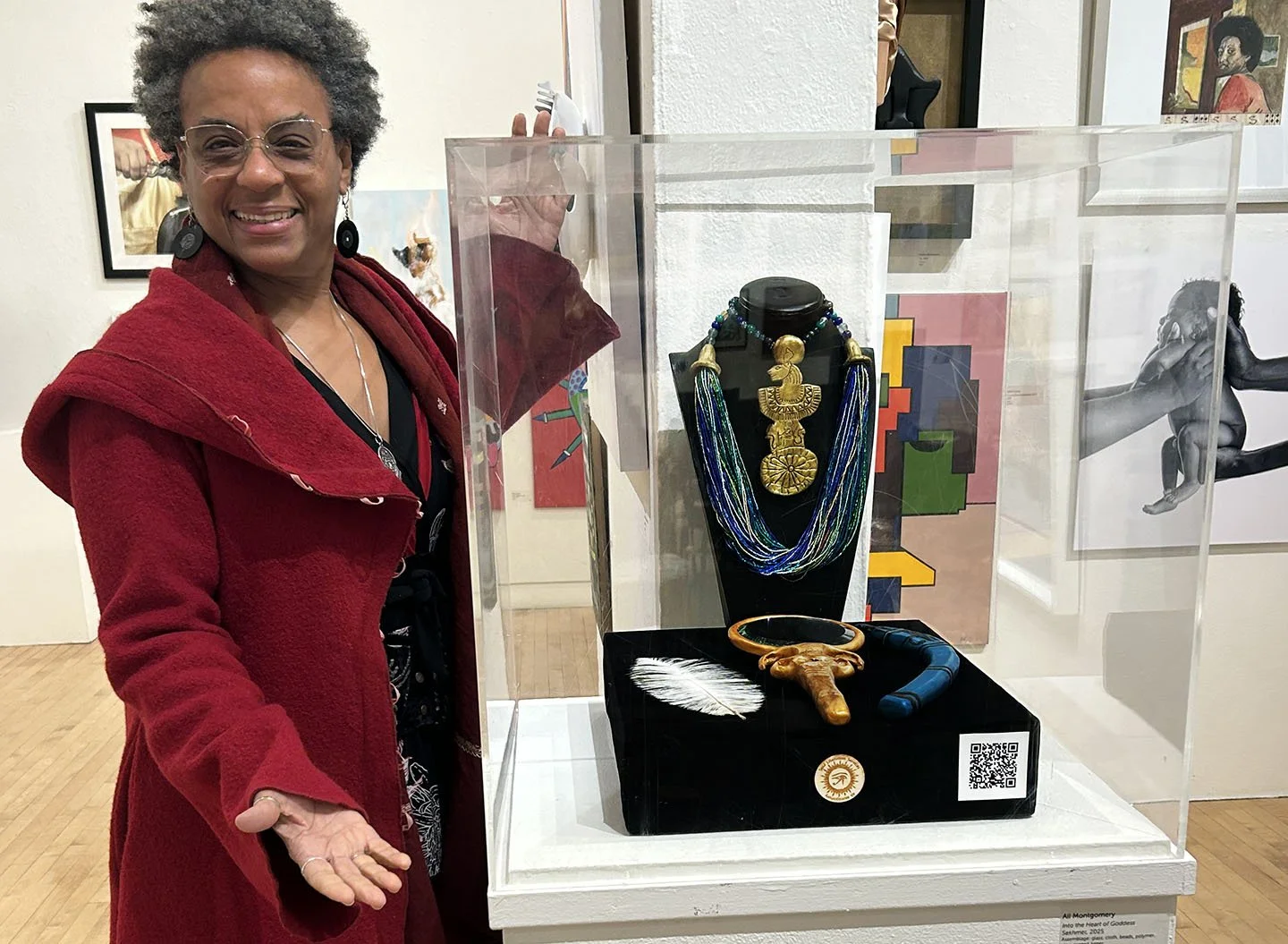
The ritual tools I have crafted for this exhibition are inspired by artifacts from 18-19th Dynasty Egypt (~1300 BCE), appropriated from their homeland and now held in the British Museum, the Metropolitan Museum of Art, and the Brooklyn Museum.
The mirror represents the solar disk, and could be used to see into the realm of the deities. The blue‑glazed throw stick, once a hunting tool, was transformed into an apotropaic wand of protection when inscribed with sacred symbols. The menat necklace, bearing the image of the Goddess, was worn by the high priestess, and could be used to convey the breath of life.
To reclaim sex-magic as sacred is to reclaim the body as holy, desire as creative force, and community as a site of shared liberation. In a world where many have been disenfranchised around race, sexuality, or spirituality, these works stand as thresholds: reminders that ancient practices of liberation can be lived again, here and now.
This exhibition is more than an offering of art. It is an invitation. Using these ritual objects, we honor Sekhmet and invite you to step into our living community of renewal, power, and sacred connection with the Goddess. Together we restore the ancient union of sacred power and sex-magic, cultivating a circle where devotion becomes practice, practice becomes community, and community becomes a vessel for strength, pleasure, and liberation.